



According to the analytics we use to keep up with Idea Email, we know there’s a 25 percent chance you’re reading this on a smartphone, most likely an iPhone. More important, those analytics remind us there was only a 15 percent chance that you’d read Idea Email on a smartphone in 2013, when we advised you to “Design first for the smallest screen.“

Earlier this week, LinkedIn announced it purchased the online educational service Lynda.com for $1.5 billion. If you are not familiar with Lynda.com, then you’ve probably never run into a brick wall trying to figure out some nuanced special effect in Photoshop or other Adobe software. With 1,124 courses related to Adobe software in the Lynda.com library, chances are good it will help solve your Photoshop mystery. And because Lynda.com breaks down those courses into 55,000 tutorials, you can find your help fast (without taking an entire course).

By Rex Hammock
Among various internet tribes, the word “trope” is used to describe labels applied to a cliché. For example, the TV Tropes wiki has a list of tropes related to Science Fiction clichés, including one of my favorites, the “Turned Against Their Masters” trope.
Just in time for March Madness, Upshot, the number nerds at NYTimes.com, ranked home-team basketball fans for their effectiveness in distracting the attention of free-throw shooters from visiting teams. With their “Curtain of Distraction” that makes each free-throw attempt an occasion for revealing newer and zanier antics, Arizona State University (ASU) students rank No. 1 in causing visiting team shooters to be distracted; opposing players score about 1.7 points less at the ASU free-throw line than they do at home.

Last week, an optical illusion related to a black and blue dress (or was it gold and white?) blew up the internet as people discovered—apparently for the first time—they can look at the same thing someone else looks at, yet see something completely different.
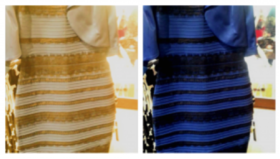 In addition to becoming an internet phenomenon (and hashtag), #TheDress provided a teaching moment for Pascal Wallisch, a research scientist at the Center for Neural Science at New York University, who used it to explain how the brain processes light bouncing off an object and perceives it as color. But the type and intensity of light and the context of the object can play jokes on our brains. And, like any joke, you may think it’s hilarious while your best friend doesn’t see the humor. In other words, we all perceive the same color in different ways. (On BuzzFeed, 3.4 million people participating in a poll say #TheDress is (A) blue and black, 32 percent (B) gold and white, 68 percent.)
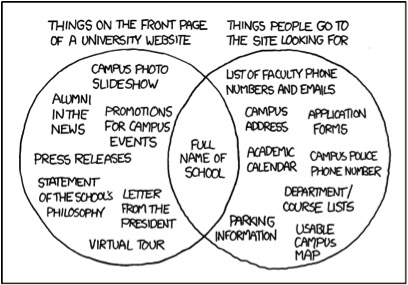
If you’ve ever participated in creating a large organization’s website, the cartoon above will generate simultaneous smiles and cringes. Why? Because it reveals a too-familiar truth of how organization websites can fall victim to something we’ve described before: Wiio’s Law, which says that communication always fails when the Guy in Charge (say, the university president) loves it. That’s because such messaging was crafted to please the Guy in Charge rather than to serve the needs of the person receiving the message.

Marketers live in an age of endless possibilities. Every day, our inboxes, news readers, timelines, tweet-streams and apps are jammed full of messages from marketing experts who are slicing and dicing data, tracking engagements, analyzing intentions and generating customer interactions with countless channels of content.

If your company hasn’t published a book yet, chances are, it’s in your future—and probably, your near future. To understand tomorrow’s book publishing, merely take a look at its history. For example, new efforts by Amazon (Kindle Unlimited), Oyster and Scribd to create a subscription-model “Netflix for books” is a throwback to Benjamin Franklin’s Philadelphia subscription library of the mid-18th century.

“Markets are conversations.”
(See update) If you are an internet-marketing trivia master, you may recognize that quotation as Doc Searls’ prophetic observation that appeared 15 years ago as part of the Cluetrain Manifesto. Cluetrain began as a list of 95 theses posted on the website Cluetrain.com that captured the sentiments of Searls and three other tech-industry marketing veterans.
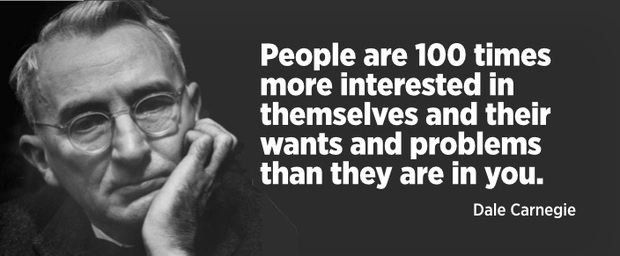
“People are 100 times more interested in themselves and their wants and problems than they are in you.” That quote may sound familiar if you’ve ever read Dale Carnegie’s 1936 classic self-help book, How to Win Friends and Influence People.