



At Hammock, we are fans of maps and the stories they help tell. We’ve created or used maps to accompany content, both print and digital, ranging from how America was formed to how food journeys through the digestive system. If you haven’t thought of maps as being a powerful storytelling medium, here are two examples we’ve seen recently that can help you view maps in new ways.

By Rex Hammock, CEO
For 23 years, Hammock’s clients have included marketers at large organizations who sell products or services to decision-makers at small businesses. From our vantage point, we’ve seen how easy it is for such marketers to fall into the trap of thinking their customers run something that’s like a big business, just smaller. In reality, the people who make buying decisions for small businesses live on another planet in a galaxy far, far away from what a big business is like.

For centuries, series of great thinkers have created their own versions of this truth:

Many years ago, we worked with a client who was convinced his company communicated with its customers too much. He felt the company had too many siloed departments that didn’t coordinate their schedules of sending physical mail and email. “If a customer belongs to all of our loyalty programs, gets all of our catalogs and mailings, they can receive 50 mailings a year,” he would say, although the number was never the same.

Recently, I met with a group of marketers whose brand faces some complex and daunting challenges in reaching a particular market segment. During the discussion, one of the participants said, “As a social media marketer, I’m concerned with measurement.”

This month marks the 25th anniversary of the first-known appearance of the acronym LOL for “laughing out loud.” BTW, LOL used for “lots of love” has been around even longer. Acronyms date back thousands of years BC or, if you prefer, BCE. How far back? The word “Tanakh,” the Hebrew name for the collection of writings in the Jewish canon and source of the Christian Old Testament, is an acronym formed from the first Hebrew letters of the words given to the sections of the canon: Torah, Nevi’im and Ketuvim.

By Jamie Roberts, Editorial Director
It goes without saying that everyone at Hammock is passionate about his or her work, but it’s equally amazing to see how intense we are about various personal passions away from the office. From coaching Little League to international travel to gourmet cooking to weight-training to backpacking, to a wide variety of church, school and community volunteer duties, our office is full of interesting people who are passionate about making the most of their time off. Recently I’ve noticed how what we learn while involved in these personal pursuits can elevate our professional lives, helping us problem-solve and look at our responsibilities in a fresh way.
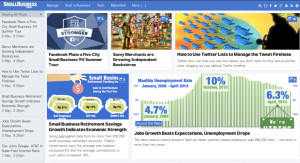 (On Rex Hammock’s RexBlog, a look at how we have developed the site SmallBusiness.com, and how we are using its lessons for other clients.)
We just flipped the switch on SmallBusiness.com’s first major technical and design upgrade since launching its daily-content Main Page section last November. (We call the new section, the “flow” side, to balance with the “know” side of the site, the 29,000 page SmallBusiness.com WIKI.)
The design changes are various, depending on what size screen you’re viewing it. However, the technical changes are all about increasing the speed of the site. And they worked. So long, little engine that could, but we know there are plenty of bugs that will show up.
(Continue reading on RexBlog.com)

The great American linguist Homer Simpson once observed about the term schadenfreude, “Boy, those Germans have a word for everything.”
Unfortunately, those of us who speak the language of marketing often do the opposite: We come up with a word that can mean everything. Rather than help us communicate, these multi-definition, ambiguous words often result in miscommunication. One current example is “engagement.” We marketers love the word so much, we use it throughout the day.

Michael Lewis’ current bestseller, Flash Boys, invites us into the world of tech-driven, high-speed, high-frequency securities trading. Marketing executives will quickly recognize the types of people, patterns and “higher truths” they have encountered during the past couple of decades of tech-driven marketing in this story set on Wall Street.