
 [Post by Rex Hammock]
I recently ran across an insightful essay named, “The best interface is no interface,” written last August on the blog of the San Francisco-based product design firm, Cooper.
I recommend reading the entire essay, but here is a key quote:
It’s time for us to move beyond screen-based thinking. Because when we think in screens, we design based upon a model that is inherently unnatural, inhumane, and has diminishing returns. It requires a great deal of talent, money and time to make these systems somewhat usable, and after all that effort, the software can sadly, only truly improve with a major overhaul. There is a better path: No UI (user-interface). A design methodology that aims to produce a radically simple technological future without digital interfaces.
At Hammock, we share a similar a point-of-view. We believe that one of the signs of great customer media and content is how well it removes barriers between customers and the organizations with which they choose to have relationships. Taken to its logical conclusion, the goal is to remove everything between the two, or, at least, to make it appear that transparent.
[Post by Rex Hammock]
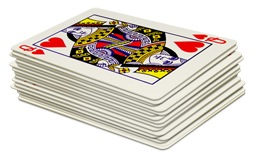
According to one theory, the word ‘deck,’ when used after the word PowerPoint, is inspired by a deck of cards and serves a metaphor for how one can arrange and shuffle the slides created on software like PowerPoint and Keynote. However, anyone over the age of 40 or who has watched Mad Men knows that old-school presentation slides weren’t stacked in decks, but were placed in the circular part of a time machine called the Kodak Carousel.
On Wednesday, the White House posted an “enhanced version” of the President’s State of the Union address on Slideshare. (If you’re reading this on the Hammock Blog, it should be embedded below.) The enhanced version is a 107-slide, yes, 107-slide PowerPoint deck. As PowerPoints go, the quality of the graphics and design are superior to 99% of the PowerPoint decks you and I have ever endured. In other words, no deficits were reduced in the production of this 107-slide PowerPoint deck. (Have I mentioned there are 107 slides in the deck?)
But is a PowerPoint deck, even a great one, the best medium to use for after-the-presentation communications?
Read on, and you’ll understand why I say, “No.”
At Hammock, one of the things we do is work with large companies to develop sales presentation systems that are intended to help lead a customer to make the decision to buy a specific product or service. The presentations in these systems don’t merely run through concepts, and, most of all, they don’t just serve as an outline to remind the sales person the next thing they want to say. They sell something.
When we first start working with a client, the most shocking thing (to the sales person, at least) seems to be when we tell them this: Never give out your deck following a presentation!
Why is it shocking? Because that seems to be a universal practice. The prospect sees something they want to remember and asks politely and with interest, “Hey, can you give me a copy of this presentation?” The sales person, not having anything else to give them, says, “Sure.”
Seems harmless enough, so why would we suggest banning the practice?
[Post by Rex Hammock]
Because Hammock has a long history of publishing print magazines while, simultaneously, serving as creators of digital media delivered to audiences via screens (starting back in the days of CompuServe and laserdiscs), I’m often asked about the future of print magazines – as in: Will print magazines still be around in the future?
Time is ticking away.
These questions typically spike whenever there is news involving closures or layoffs at once-powerful magazines like Time or Newsweek. or when a famous person like a Facebook co-founder sparks a lot of media coverage for buying a magazine like The New Republic.
Here’s my quick answer to the question, “Will print magazines be around in the future?”:
“Yes, but…”
For a much longer version of this answer – a version with predictions covering all types of print magazines – read on…

©Thinkstock
[This post is part of the series, The Basics of Customer Media and Content. A version of this post previously appeared on the blog of Rex Hammock, RexBlog.com]
There are two kinds of online content* that really matter to customers: 1. Chronological content (or what at Hammock, we call, Flow Content), the type of news and information that keeps us abreast of what’s happening now, real-time, that is of importance to us in our work or personal lives. 2. Contextual content (or what we call, Flow Content), the type of every-green content that provides us the understanding and knowledge when we need it.
Flow Content: This is the content that’s important because of its time-stamp. It is a never-ending stream and river of news and information that comes when the sender decides we should receive it, not necessarily when we expect or need it. It comes in the form of tweets, updates, email, text-messages, RSS feeds, etc. We can’t live without it. Often, it’s this kind of Flow Content that customers say over-loads them. That makes sense, as it over-loads all of us, especially if we don’t know how to organize it. In that case, we ignore it.
“When we’re marketers, we think our job is to flex our brand muscles and tell the world how great our company and product are.”
[@Getty Images / Thinkstock]
Except when we’re at work, those of us who have marketing jobs aren’t marketers, we’re customers.
When we’re not at our marketing jobs, we experience the world of commerce through the eyes of a customer. We make purchasing decisions and interact with companies — all while in the role of buyer, not seller; as a user, not a maker or supplier.
We all are experts at being customers, perhaps even more than we are experts at being marketers.
But too often, when we punch in our time-cards at the marketing factory, we leave that expertise at the door.
For example, when we are customers, we buy products from companies that tell us how great we are — and how their product is all about helping us be or do what we want to be or do.
But when we’re marketers, we think our job is to flex our brand muscles and tell the world how great our company and product are.
When we’re marketers, we think our job is to target customers. But as customers, we’re tired of being target practice.
The secret to successful marketing is to stop being a marketer.
Stop cranking out all that hype you can’t stand to receive when you’re a customer.
Stop telling customers how great you are — and start helping them be great at something they want to be.
You know all this — at least you do when you’re not at work.
 [By Rex Hammock, cross-posted on RexBlog.com]
A comment by Facebook CEO Mark Zuckerberg yesterday is being given a lot of coverage by tech media and the financial press. However, outside a specific context that Facebook faces, the quote could be confusing to non-tech business decision makers — especially when interpreted to be true in all cases, and not specifically in Facebook’s situation.
Here’s the quote: “The biggest mistake we made as a company was betting too much on HTML5 instead of native … We burnt two years.”
While it is easy to think of many Facebook mistakes far worse (that whole IPO fiasco, for instance), the point of this post is not to debate his quote. The point of this post is to encourage businesses that may have a perfectly wonderful reason for using HTML5 to avoid associating it with the phrase, “biggest mistake.”
 Over the weekend, the smart and successful VC Fred Wilson used the metaphor of TV shows vs. TV networks to suggest that investors (and the rest of us) sometimes (often?) confuse the significance of various kinds of web-based startups.
Anyone who has used the Internet for more than five years should immediately recognize what he’s suggesting. Some things we believe will define the future — things that are so disruptive they will do away with institutions that have been in place for centuries — turn out to be “I Love Lucy” or MySpace.
If I were to debate this topic (and I’m not), my position would be this: In this metaphor TV is “the Internet.” Everything else is a TV show.
Do you recognize the guy with the cigar in the photo accompanying this post? He was a comic character, Raymond J. Johnson Jr., created by comedian Bill Sagula in the 1970s, who was forever introducing himself to anyone he’d meet with a string of names, like: “You can call me Ray. And you can call me Jay. And you call me Ray Jay. Etc.”
At Hammock, we are beginning to feel like Ray (or Jay or RJ, or RJJ) …
When Hammock Inc. started more than 20 years ago, the services we provided (and still provide) put us into a segment of the marketing and media world called “custom publishing.” We considered our service to be assisting our clients in building strong relationships with customers, something we thought “loyalty marketing” was a good term to describe.
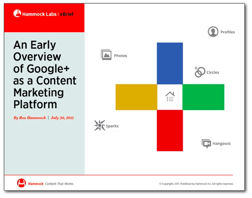 Last July, Hammock Labs issued a brief ebook (we called it an “ebrief”) that reviewed and analyzed Google Plus. We were intrigued enough by Google’s brand new service that we broke our rule of giving a new service and platform a break-in period before suggesting any client use it.
When first launched, Google Plus was not open to company pages, so we suggested individuals log on with their Google accounts and try it out.

New York Life, Insurance Magazine, 1942
[Cross-posted in RexBlog.com]
For some reason, every few months or so, a reporter will discover that a consumer or business product company has launched a magazine or web property designed to communicate directly with its customers — and will write about it as if this were some newly discovered form of marketing. As launching and managing such media properties is what I have done for much of the past 25 years, I am pleased that such an approach to marketing is continuously treated as something new and fresh and cutting-edged, despite having been around since the 1800s.