




Credit: ThinkStock
The current Hammock Idea Email points out the folly of investing in tactics advocated by those who promise they can magically improve the way Google ranks a company’s website. “You’ll never out-smart Google, so stop trying,” we advise.
Overtime, the only way to influence Google’s ranking is to, first and foremost, have a great product or service. Then follow Google’s guidelines and recommendations rigorously. This means, create a website filled with the most helpful, insightful information your customers look for related to the market niche your company serves.
With the release of the fourth version of Google’s war on link spam, an upgrade to the company’s algorithm they are calling Penguin 2.0, the message is clear: Try to outsmart Google and you’ll likely be penalized in the future.
There are dozens, make that hundreds, of things you can do to improve your site’s findability. Here are just five things you can do to make your site Pengiun 2.0-friendly:
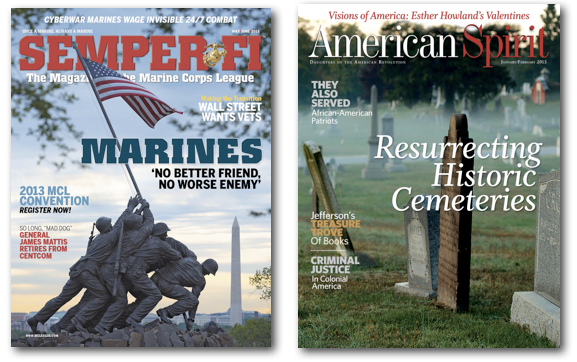

Bonus Link: On his blog, Rex Hammock shares his favorite route to our new offices in Downtown Nashville.
 Recently, Chris Brogan invited Hammock CEO Rex Hammock onto his very popular podcast where they talked about how companies, associations and other organizations are using media and content to connect directly with their customers.
Last year, Forbes ranked Chris #1 on its list of top social media influencers. His books have appeared on the New York Times’ business bestsellers list and he’s in demand as a speaker, presenter and consultant.
Chris and Rex discuss a wide range of topics related to how customer media is helping businesses address bottom line challenges and opportunities. It lasts approximately 25 minutes and is an enjoyable listen for marketing geeks of all ages.

A successful customer media strategy hinges on what advertisers have long called “frequency” — the number of times a customer must be exposed to a message for it to be effective.
“One-and-done” customer media will disappoint your customers, as sure as “one-and-done” disappoints fans who see their team lose in the first round of the playoffs.
Recurring media is king. So recurring (and subscribable) media like magazines, newsletters, frequent blog posts and podcasts have been the early and effective tools of digital content marketers.
 Our current Idea Email is focused on the customer relationship-building opportunities of using a subscription model for the distribution of ebooks.
Here are 5 tips we believe will help such a series of ebooks to become popular with your audience.
Keep it Short
By short, we mean 5,000-10,000 words. This is the length of a long magazine article. A business-to-business marketer may offer longer books, if your audience seeks content of a technical or academic nature. And a how-to or recipe series may be comprised of ebooks with less words. However, the success that Amazon.com has seen with Kindle Singles

 David Ogilvy, the real-life Don Draper of Madison Avenue in the 1960s, is perhaps the most quoted, and misquoted, person in the history of marketing. One of his most popular quotes was about headlines: “On the average, five times as many people read the headline (of a print ad) as read the body copy. When you have written your headline, you have spent eighty cents out of your dollar.”
That quotation is sometimes used by digital marketers as guidance for how to reach today’s short-attention-span customer. Say everything you need to say in the subject line, they advise. “If you can’t say something in 140 characters, then don’t say it,” we’re told.
Unfortunately, in the cited quotation, Ogilivy didn’t mean you have to say everything you need to say in a headline.
How do we know he didn’t mean that? Because the quote is buried deep inside an advertisement containing 1,909 words of copy. You read that correctly: 1,909 words!
Moreover, Ogilvy includes the following advice a few paragraphs later: ”People read long copy…. readership falls off rapidly up to 50 words, but drops very little between 50 and 500 words: The more you tell, the more you sell.”
For Ogilvy, advertising wasn’t merely about getting people to read your headline. It wasn’t even about getting people to read body copy. It was about one thing: selling.
Use short copy to sell. Use long copy to sell. Just make sure your advertising sells. Everything one does as a marketer is in service to the sell.
How to create customer media that sells
Hammock’s Idea Email of May 2, 2013, uses several quotes by the real-life Don Draper of the 1960s and early 70s, David Ogilvy, to show that when it comes to customer media and great content of all types, there is a time and place for short, snappy writing and a place for longform communication.
But there’s no place for content that doesn’t serve, in some way, “the sell.”
We refer to the accompanying ad in our email, one of a series of “house ads” Ogilvy wrote that are credited with helping his company, Ogilvy & Mather, grow into one of the world’s largest networks of marketing companies. It is a remarkable ad for many reasons, but our focus today was how one quote in it (#35) is often used to suggest that today, if you can’t limit your message to 140 characters, then you might as well not say it. Yet few of the people who use that quote realize it is buried in 1,909 words of advertising copy.
In addition to the image file (click on it to see a larger version) of the ad, itself, we’ve reproduced the copy from the ad so that you can read it and note how little hype there is in the copy — just good, informative and helpful advice. The nuanced, unspoken message in the copy is this: In the 1960s and 70s, if you wanted to work with the folks who were creating the new rules of advertising, then you needed to hire O&M (or, perhaps, Sterling, Cooper, Draper, Pryce).
After the jump, read the entire ad.
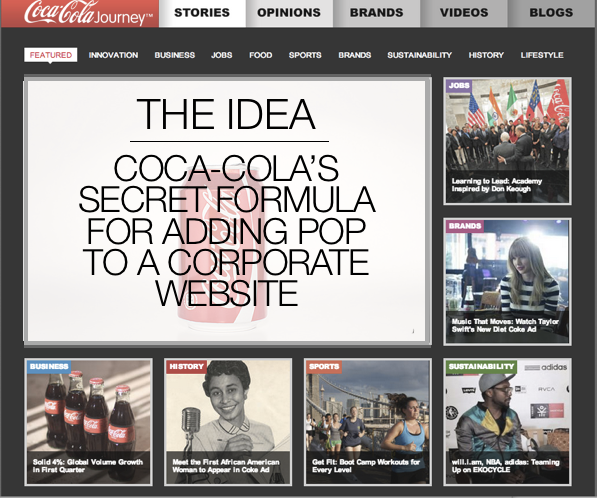
After a radical overhaul, the corporate website of Coca-Cola (Coca-ColaCompany.com) now demonstrates how story-focused customer media and engaging content isn’t just for product marketers anymore.
