



This week and next, we are bringing you our 10 predictions for 2014 related to the media, content and technology used by marketers to communicate directly with customers, members, clients, et. al. Some will be quite obvious—the incremental, “around the edges” innovation that is most common. Other predictions will fall outside the box of conventional wisdom—the more significant and surprising way the future arrives.

Several hundred readers have subscribed since we sent the first Idea Email during the week of Thanksgiving last year. As the following has been one of the most shared emails we’ve sent, and because we can’t say it enough, we’ve decided to make it an annual tradition.

Ask a professional photographer to recommend the best camera, and the answer will be something like, “the one you have with you when a great photograph suddenly appears.” The photographer has all sorts of cameras and equipment back at the studio, but they’re useless when a timeless moment occurs elsewhere.

Why do bad presentations happen to good companies?
Here’s a familiar scene: A sales professional from your company gets the chance to make a presentation to a group of potential customers. He carefully prepares a PowerPoint presentation that includes a bullet point for each of the ways your company is special and all the features and specifications your product includes. The presentation begins. With each new slide, the potential customers read the bullet points much faster than the speaker is reading them aloud, immediately throwing presenter and viewer out of sync. Afterward, the speaker hands out copies of the PowerPoint slide deck so the audience can recall important ideas later. But those bullets are shorthand prompts, not detailed notes, so the presentation ultimately makes little sense to anyone when they pull it out to view another day.

In our last Idea Email, we proposed that metrics like “pageviews” and “followers” are quickly becoming horse-and-buggy-era tools in the Internet’s supersonic content-enabled marketplace. The only metrics that matter, we said, are those that: (1) generate revenue and (2) lower costs.
So what kind of content accomplishes those goals?
We’ll tackle content that lowers costs in a future Idea Email. First, though, here are five types of content that generate revenue in direct and measurable ways.

Here is a story about the history of Web metrics.
In the early days of the Web browser, publishers and marketers had to agree on how to determine the value of website advertising. Those ad buyers and sellers understood traditional print and broadcast media metrics: eyeballs and demographics. They applied a similar passive metric—pageviews—to the new medium.
What they didn’t consider is that, unlike traditional media, the Internet isn’t just a passive medium where one views or reads content. It’s a medium that allows one to act and to interact—to purchase or join or convert or support or endorse instantaneously.

At Hammock, we have published both print and digital publications for over two decades. There are many things print publications can convey and accomplish that will never be achieved on a screen. Likewise, there are many things about a digital publication experienced on the screen of an iPad or Kindle that are rapidly gaining popularity among readers.
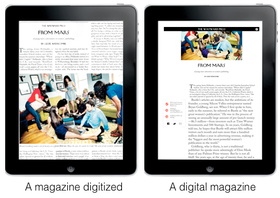 So, we believe in the power of both print publications and digital publications. But, we strongly suggest that if you want readers to find your publication compelling on a screen, know that you can no longer merely replicate the format of the print version and post it on the Web.
We even use two different terms to describe publications that are delivered to readers via the Internet. The first is a “digitized publication” which refers to a publication that is designed originally for print. The print layout is then converted into a digital format that resides on the Web in a way that attempts to replicate a print magazine in a virtual fashion — they are the publications you see that look like PDFs with the added feature of allowing you to pretend you are flipping page.

Two years ago, Bret Victor, a former Apple designer whose job was to experiment with new ways for users to interact with technology, wrote a blog post titled, “A Brief Rant on the Future of Interaction Design.” In it, he challenged developers to broaden their visions of future interactions with technology beyond the cliché of pointing and dragging with one’s fingers. Why use just fingers when you can use a person’s entire hand, or even their entire body? he asked.
Jeff Cornwall, Belmont University entrepreneurship professor and longtime blogger (The Entrepreneurial Mind), recently invited Rex Hammock to appear on the video version of his blog — a show produced by the Nashville-based web video network, Talkapolis. In the 10 minute episode, Rex explains the customer media and content focus of Hammock Inc. — and our role in the context of today’s marketing landscape.